
Criminal Cases in the Duplin County Courts
Duplin County criminal cases belong to North Carolina's General Court of Justice. Superior Court tries felonies. District Court handles misdemeanors and infractions, as well as first appearances and other early felony proceedings. A criminal District Court conviction may be appealed to Superior Court for a new trial. Wallace, Warsaw, and Rose Hill do not run municipal courts, so cases that begin with those police departments enter the same state court structure.
The Duplin County court hub links calendars, services, and eCourts tools. The Clerk of Superior Court is custodian for files in both court divisions. The district attorney screens charges and prosecutes them, while magistrates handle the first judicial process and release decisions. Those roles create different parts of a case, but the clerk-held file is the place to trace the filed charge through its result.
The North Carolina criminal-case overview shows how state criminal matters proceed.
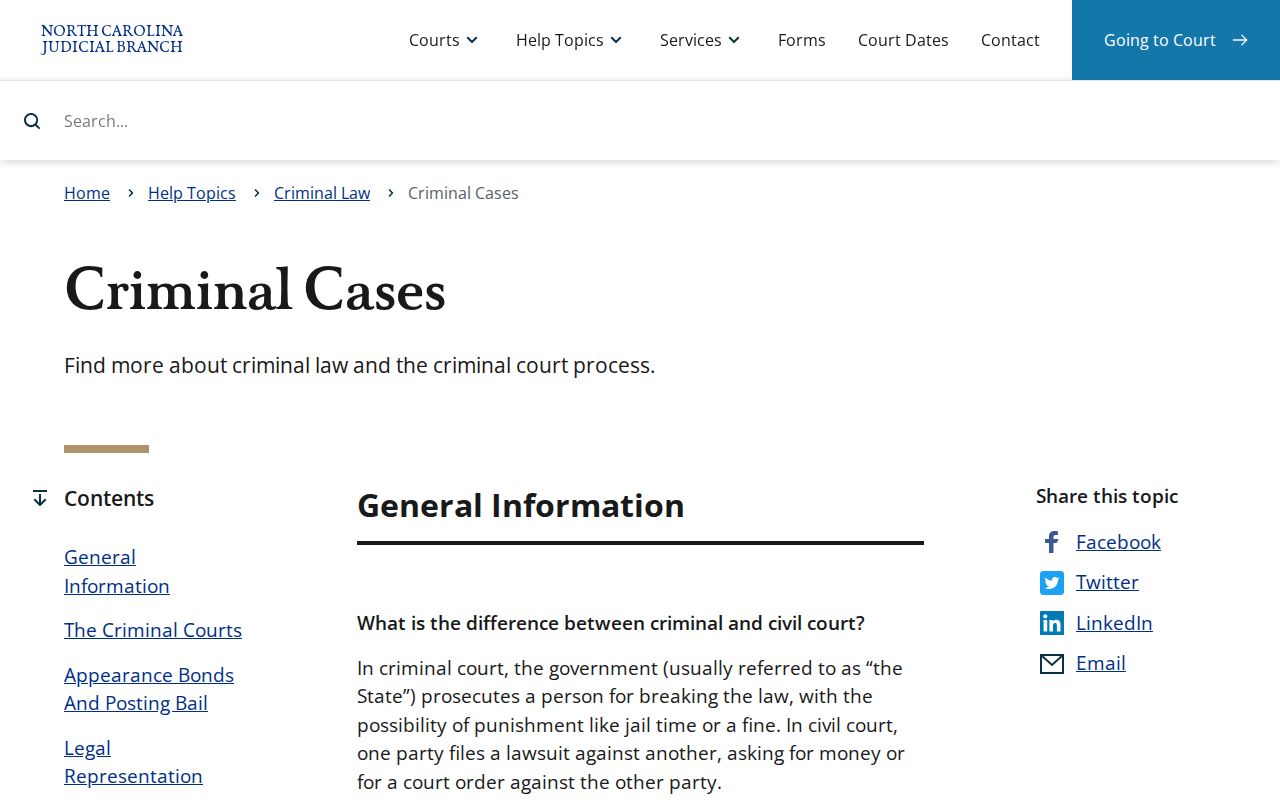
That statewide process supplies the framework for each Duplin County docket, from the initial accusation to judgment and any appeal.
Duplin Criminal Case Search Fields
Duplin County joined North Carolina eCourts on February 3, 2025. The public Portal can locate a case by party information, a complete case number, an attorney, or a citation. Set the location to Duplin and choose the criminal or infraction category. That county filter matters when a name is common. Search a legal name and any known alias separately, and use the full file number when it appears on a citation or court notice.
The public fields vary with the chosen search path. A blank field does not mean the information does not exist, and an online no-result does not prove that no older case exists.
| Field Label | Type | Required | Use |
|---|---|---|---|
| Location / County | Dropdown | Optional | Select Duplin to reduce same-name results |
| Case Number | Text | Conditional | Enter the complete year, type, and sequence |
| Last / Business Name | Text | Conditional | Try spelling and alias variations separately |
| First and Middle Name | Text | Optional | Use to narrow a common last name |
| Filed Date From / To | Date | Optional | Limit results to a filing period |
| Case Type / Category | Dropdown | Optional | Choose criminal or infraction as needed |
| Citation Number | Text | Conditional | Use the number printed on the citation |
How to Search Case Records
Begin online when the person, case number, or citation is known. Then use the courthouse channel whenever a result is uncertain or certification is needed. This order preserves the speed of Portal without treating its public display as a complete official file.
- Open the North Carolina eCourts Portal and choose the party, case, or citation search path.
- Select Duplin County and the criminal category, then enter the strongest identifiers available.
- Open the likely match and compare the case number, court division, filed date, and each charge sequence.
- Read the register of actions and each current disposition. Check future events against the official Duplin criminal calendar.
- Call or visit the clerk for a paper file, an archived matter, a copy, or a certified record.
A certified Duplin-only name search uses form AOC-CR-314 and costs $25. A courthouse public terminal permits free noncertified searching, with possible print charges. A mailed request uses a money order or certified check, not a personal check. In-person payment may be made by cash, card, money order, or certified check. The Judicial Branch directs people who need a criminal record search to the clerk rather than treating Portal as that product.
Note: Portal document availability varies, so never assume an electronic download is free or that every paper in the file appears online.
Duplin Criminal Court Divisions
The court label shows where a Duplin County case stands. District Court hears misdemeanor trials and early felony events. A felony can include a first appearance, probable-cause hearing, or waiver there before an indictment sends the matter to Superior Court. Superior Court then handles arraignment, motions, plea or trial, judgment, and sentence for the felony prosecution.
This division prevents a common search error. Finding a felony event in District Court does not show that District Court reached the final result. Likewise, a later Superior Court file may use a charge that differs from the arrest caption. Appeals from a criminal District Court conviction commonly proceed to Superior Court for trial de novo, which means a new trial rather than a review confined to the lower record.
| Duplin Court | Typical Criminal Work | Search Point |
|---|---|---|
| District Court | Misdemeanors, infractions, initial felony stages | Read events and current charge status |
| Superior Court | Felony trial and disposition; de novo appeals | Look for indictment, plea, verdict, and judgment |
| Clerk of Superior Court | Custody of both divisions' case files | Request terminal access, paper files, copies, or certification |
What the Case File Shows
A Duplin County case file records the prosecution as it changes. The header identifies the file, division, type, filing date, status, and disposition date. Charge rows can preserve an original accusation while also showing the current charge and result. The event register then places process, hearings, motions, plea or trial, judgment, appeal, and compliance events in sequence.
| Case Number & Court | File number, Duplin location, District or Superior division, case type, and status |
|---|---|
| Parties | State of North Carolina, defendant, and attorneys of record, with protected identifiers redacted |
| Charges | Offense label, statute, offense date, sequence, class, and current disposition |
| Docket Entries | Process, appearances, indictment, continuances, motions, plea, trial, judgment, and later events |
| Hearings | Date, time, location, session or courtroom when assigned, and hearing type |
| Disposition & Judgment | Outcome for each charge, sentence, costs, fine, restitution, and other terms when public |
| Documents | Available eFiled papers; sealed, confidential, expunged, and non-digitized items are excluded |
The filed case is distinct from a booking record or an SBI fingerprint history. A reader following an arrest into court can use the full Duplin County arrest history process to understand where the first custody entry came from.
Duplin Court Clerk Record Fallback
The clerk counter is the required fallback when Portal has no result, shows a cryptic event, or lacks an older paper. The Duplin County Courthouse is at 112 Duplin Street, Kenansville, NC 28349. The clerk's main number is 910-275-7000, and courthouse hours are weekdays from 8:30 a.m. to 5:00 p.m. The mailing address is PO Box 189, Kenansville, NC 28349.
Ask for public-terminal access, a paper-file inspection, a plain copy, a certified copy, or the $25 certified county criminal search. Public terminals may search county or statewide court data without a search fee. The paper file must be inspected where it is maintained. Give the full case number when possible, and say whether certification is needed.
The official Duplin court contact directory identifies the clerk, district attorney, magistrates, and judges.
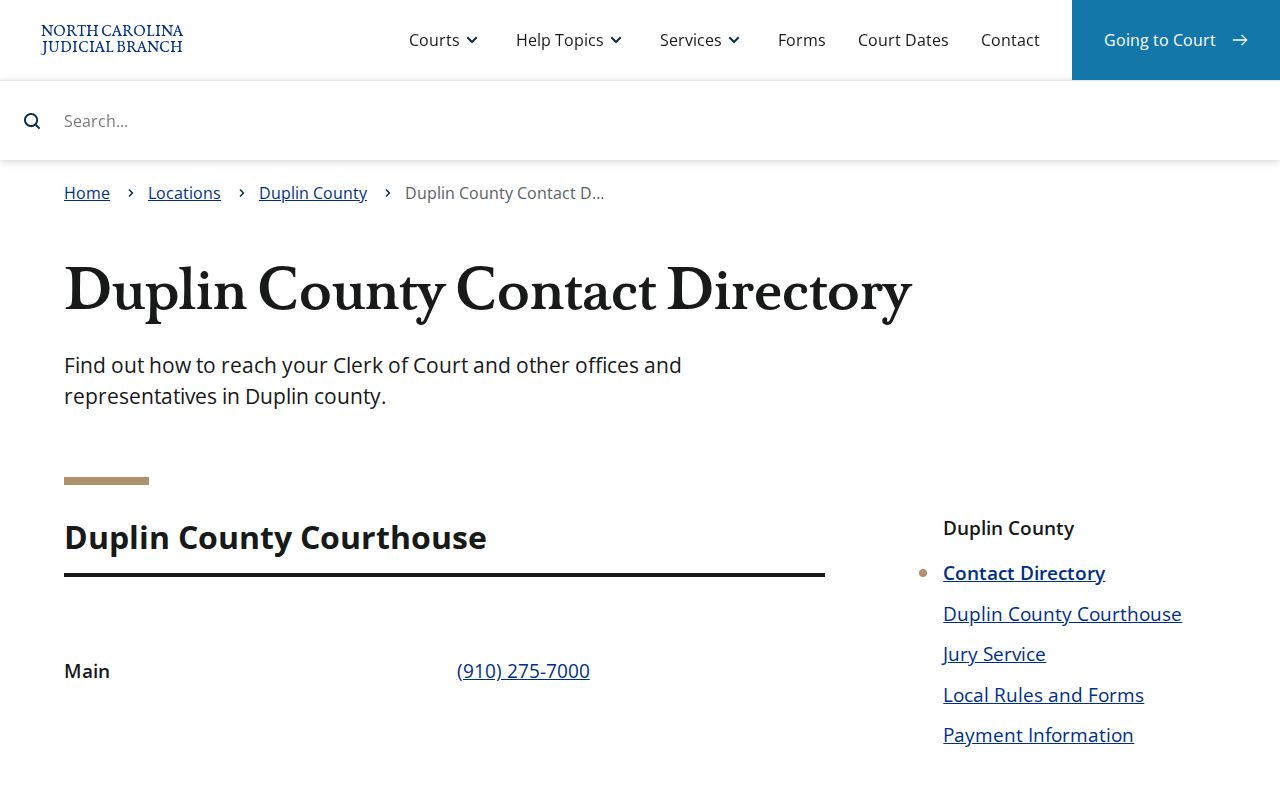
The directory helps route a records question to the clerk rather than to an office that cannot certify or release the case file.
Duplin Clerk of Superior Court
112 Duplin Street
Kenansville, NC 28349
910-275-7000
Weekdays, 8:30 a.m. to 5:00 p.m.
Stages of a Criminal Case
A Duplin County criminal file may begin after an investigation, arrest, or citation. A magistrate addresses probable cause and release conditions. The district attorney then screens the matter. A misdemeanor stays in District Court unless appealed, while a felony may proceed through a probable-cause hearing or waiver and grand-jury indictment before moving to Superior Court.
Case flow: Charges Filed › Arraignment › Pretrial › Plea or Trial › Disposition › Sentencing
Post-judgment events and appeals can follow. The sequence matters because the arrest offense, filed charge, and conviction may all differ. An indictment is an accusation. A true bill shows that the grand jury returned the charge, not that guilt was proved. A nolle prosequi records a prosecutor's decision not to continue a charge at that time.
Note: “Disposed” only means a charge reached an outcome; open the disposition row to learn whether it was dismissed, convicted, or resolved another way.
Reading Duplin Case Dispositions
A case caption can outlive the charge it first described. Read every charge sequence and its present disposition. “Dismissal” means that charge ended without conviction, but it does not by itself erase the connected arrest or agency report. “Not guilty” is an acquittal. A conviction follows a plea or verdict and should be read with the judgment and sentence.
Several terms need care. An arraignment is the stage at which charges are formally addressed and a plea may be entered. A deferred prosecution delays prosecution while conditions are completed and is not the same as a conviction. An order for arrest directs law enforcement to take a person into custody, often after nonappearance or noncompliance. Issued, unserved, returned, reset, and recalled entries describe process status, not guilt.
- Disposition
- The outcome of one charge, such as conviction, dismissal, not guilty, or deferred resolution.
- Indictment
- A grand jury's formal felony charging instrument, which remains an accusation.
- Judgment
- The court's formal ruling, including the sentence and conditions after conviction.
- Criminal calendar
- A schedule for a court session, not a full criminal history.
Duplin Case Portal Limits
Portal is useful, but it is not the official record. Duplin County's present courthouse dates to 1913, while eCourts arrived in 2025. Older holdings may remain on paper or outside the public electronic view. A no-result search cannot be printed as proof that no case exists, which is another reason to use the clerk's certified search when that assurance is needed.
The Judicial Branch court-records instructions explain public terminals, file inspection, and copy routes.
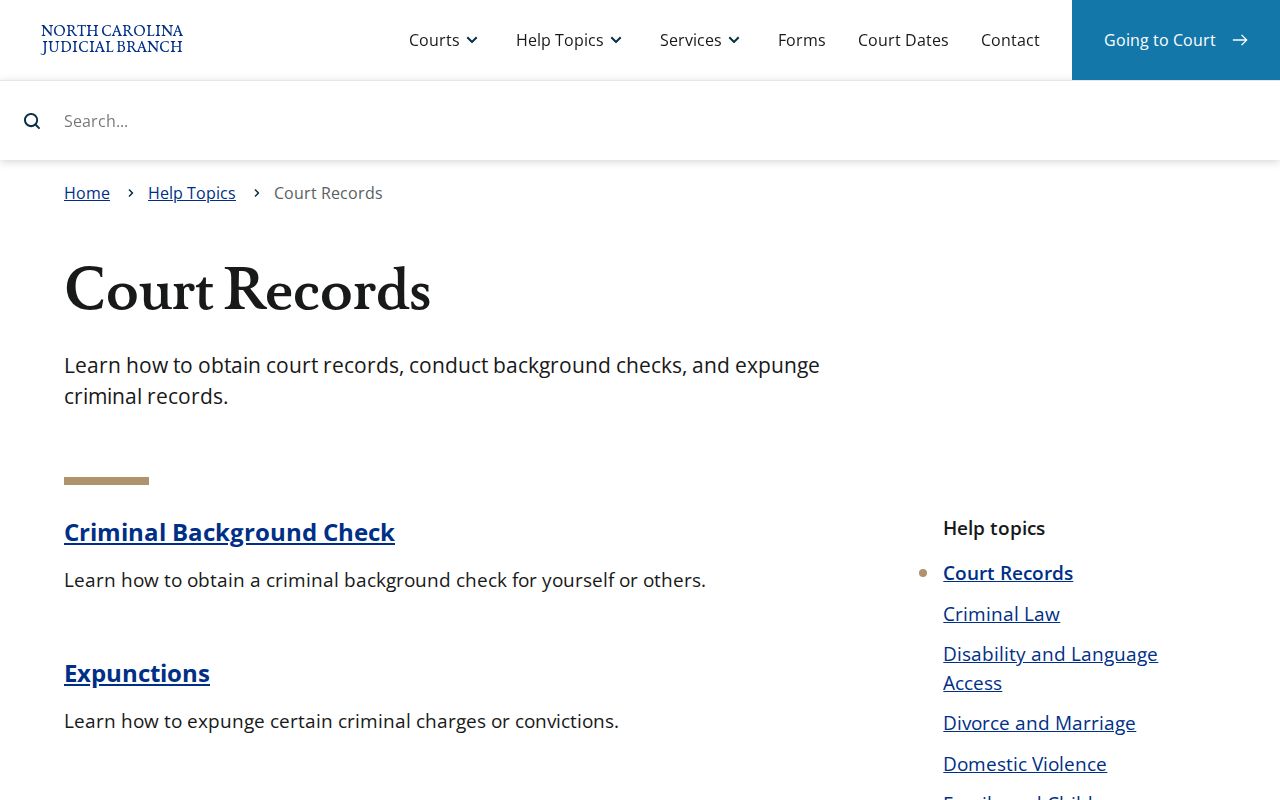
Those channels remain vital for converted entries, archived cases, and papers that were never digitized.
Legacy events converted into eCourts can carry a 12:00 a.m. time. That may be a migration timestamp rather than proof of a midnight hearing. Online financial data also needs context: an original judgment amount may not equal the current balance after payments or adjustments. Verify unclear entries with the clerk.
Access & Restrictions
North Carolina law generally opens clerk records for inspection at reasonable times. G.S. 7A-109 governs court-file access, while Chapter 132 governs county and law-enforcement records. They are not interchangeable request systems. A court-file request goes to the Duplin clerk, not the county administrative records inbox.
Juvenile files, expunged matters, sealed filings, sealed indictments, victim and minor information, and full personal identifiers are restricted. Public Portal views can redact more than a paper file, but the paper file is also subject to legal limits. An eFiled document may be available online, while a sealed, confidential, expunged, or non-digitized paper will not be.
Public access rule: Ask the clerk about an absent record and the legal basis for any restriction; do not infer a case outcome from a missing online result.
For an expunged file, G.S. 15A-151 sharply limits later disclosure. A granted expunction can take time to reach connected systems, so a person reviewing their own record should keep the order and follow the clerk's correction instructions.